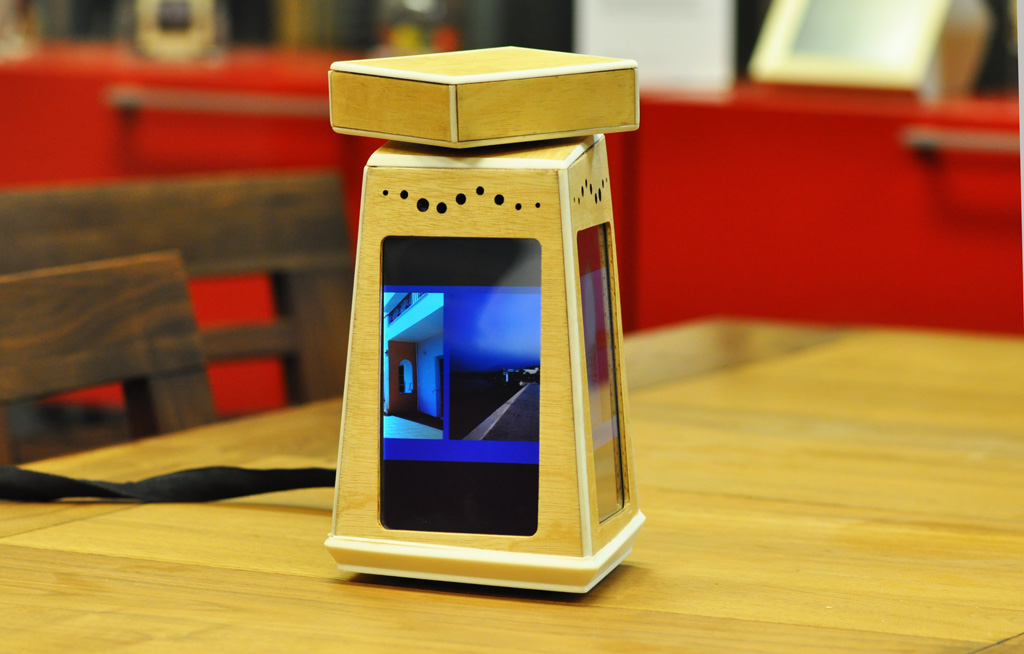
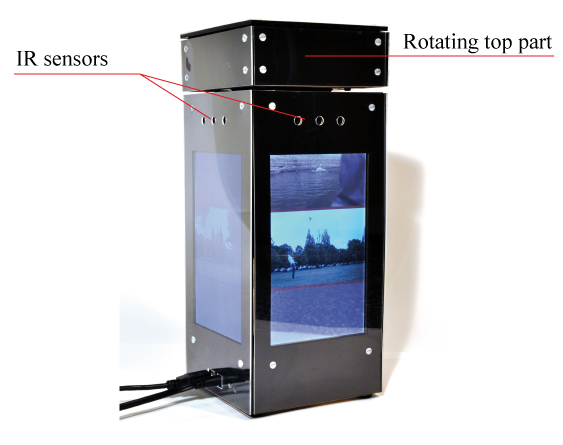
4Photos is designed to be positioned on a dinner table. A dinner table naturally configures people to gather for social occasions like dinner and drinks. The aim of 4Photos was to exploit this natural configuration and provide a way for everybody around the table to view and interact with the artifact while maintaining natural gaze and interpersonal awareness The content for on the device is sourced from online media repositories, as for example Facebook. The photos from a person in a friend group of the user are clustered within a “photostrip”. With this photostrip the four displays create a linked display surface on which the photostrip moves around.
Video introduction of 4Photos.
Interaction
The device is composed of 4 vertical sides, each side framing a small portrait oriented display and a distance sensor. Being positioned on all four sides of the object, these sensors can detect gesture and movement towards the displays from each side. This gesture is used to zoom in and push the same image to all screens providing users with a coordinating function to highlight and talk about a photo. The rotatable part on top of 4Photos, the “head” allows users to select between content from different people.
Microsoft Research
In the summer of 2009 I worked and lived for three months in the exciting environment of Microsoft Research in Cambridge, UK. Here I was responsible for an individual project within the Socio-Digital Systems Group (now Microsoft Research Cambridge Lab supported by full time researchers and post-doc employees. The result of this internship was the iterative design and user study of “4Photos”, a multi-screen table centerpiece allowing media content to be shared and enjoyed in a social setting. Together with Microsoft colleagues we evaluated the design and reported on the results in a publication during the NordiCHI 2010 conference in Reykjavik and reported further in the prestigious Human-Computer Interaction Journal. A patent has been awarded for the design.
Detail of the rotating head of the device, the holes incorporate the gesture sensors.
Details
Designers: Martijn ten Bhömer, John Helmes
Advisors: John Helmes, Kenton O’Hara, Abigail Sellen (Microsoft Research), Elise van der Hoven (Eindhoven University of Technology)
Materials: Birch wood, 3D-printed construction elements, PIR distance sensor, Rotary encoder, External displays, USB hub, Computer
Techniques: Laser cutting, 3D printing, Soldering, Programming
My role in collaboration: Initiator of the project, Conceptual design, Interaction design, Technology integration, Programming, User Interface design, User-centered design and validation
Photographic mementos are important signifiers of our personal memories. Rather than simply passive representations of memories to “preserve” the past, these photos are actively displayed and consumed in the context of everyday behavior and social practices. Within the context of these settings, these mementos are invoked in particular ways to mobilize particular social relations in the present. Taking this perspective, we explore how photo mementos come to be used in the everyday social setting of sharing meal. Rather than a simple concern with nutritional consumption, the shared meal is a social event and important cultural site in the organization of family and social life with culturally specific rhythms, norms, rights, and responsibilities. We present a system—4 Photos—that situates photo mementos within the social concerns of these settings. The system collates photo mementos from those attending the meal and displays them at the dining table to be interacted with by all. Through a real-world deployment of the system, we explore the social work performed by invoking these personal memory resources in the context of real-world settings of shared eating. We highlight particular features of the system that enable this social work to be achieved.
@article{food-for-talk,title={Food for Talk: Phototalk in the Context of Sharing a Meal},author={O'Hara, Kenton and Helmes, John and Sellen, Abigail and Harper, Richard and {ten Bhömer}, Martijn and van den Hoven, Elise},year={2012},month=apr,journal={Human–Computer Interaction},publisher={Taylor \& Francis},volume={27},number={1-2},pages={124--150},}
2011
Device for Sharing Photographs in Social Settings
Martijn ten Bhömer, John Helmes, Kenton O’Hara, and 2 more authors
A device for sharing photographs in social settings is described. In an example, the device comprises a display surface which extends around a vertical axis of the device such that it provides a cumulative viewing angle of greater than 180°. This enables viewers located all around the device to see images displayed. The display surface may be a continuous display or may be formed from multiple discrete displays. The images displayed comprise sets of related images which may, for example, be accessed from an online image store (such as a social networking site) or other storage device. In an example, sets of images may be displayed in the form of filmstrips, with each filmstrip comprising a set of related images associated with a different user. Where the device includes a user interaction element, detection of a user interaction changes the images that are displayed.
2010
4Photos: a collaborative photo sharing experience
Martijn ten Bhömer, John Helmes, Kenton O’Hara, and 1 more author
In Proceedings of the 6th Nordic Conference on Human-Computer Interaction: Extending Boundaries, Reykjavik, Iceland, Oct 2010
In this paper, we describe the iterative design and user study of "4Photos", a multi-screen table centrepiece allowing media content to be shared and enjoyed in a social setting. It was our intention to design an object with the purpose to gather qualitative data concerning the social effects of new ways of democratic, serendipitous and playful photo sharing. To facilitate this we used online photo repository content that most often gets experienced in an individual setting. Using 4Photos we positioned this content within a social setting and observed how the presentation of these images enabled new ways of ’phototalk’ to arise. We describe the design process, the final concept and reflect upon observed practices that emerged from people’s usage of 4Photos. We then present several design implications and discuss future directions for continuation of this research.
@inproceedings{collaborative-photo-sharing-experience,title={4Photos: a collaborative photo sharing experience},author={{ten Bhömer}, Martijn and Helmes, John and O'Hara, Kenton and van den Hoven, Elise},year={2010},month=oct,booktitle={Proceedings of the 6th Nordic Conference on Human-Computer Interaction: Extending Boundaries},location={Reykjavik, Iceland},publisher={Association for Computing Machinery},series={NordiCHI '10},doi={10.1145/1868914.1868925},isbn={9781605589343},}