Keeping dementia patients in touch with their families
Keeping dementia patients in touch with their families
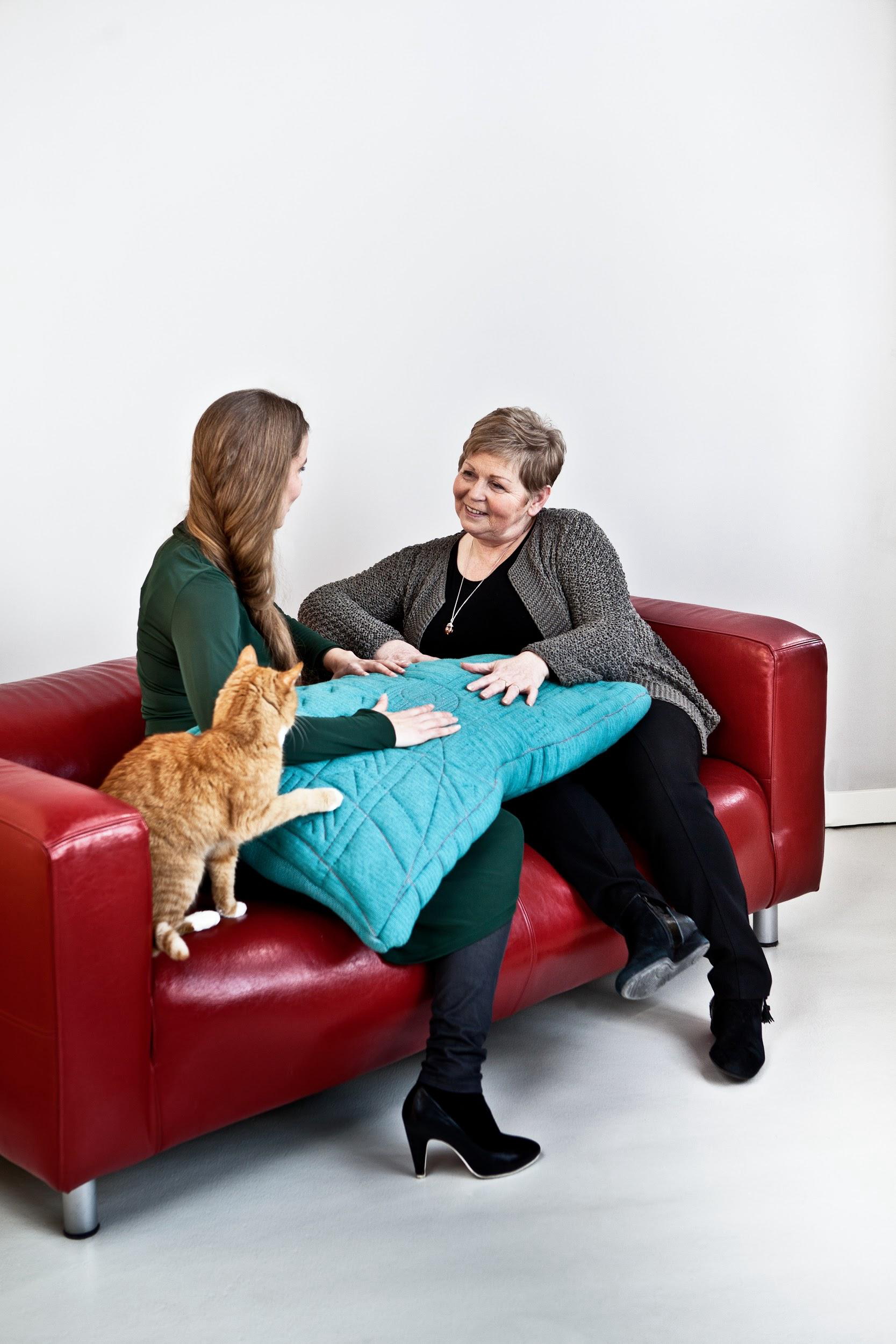
Tactile Dialogues is a Smart Textile Service which consists of a textile object in the form of a pillow with integrated vibration elements that react to touch. The goal of the textile object is to enable a dialogue by triggering physical communication patterns between a person with severe dementia and a family member, spouse, or other caregiver, by a joint interaction with the product.
Video of the stakeholders explaining the value of Tactile Dialogues.
Bodily conversations
The pillow provides various vibrotactile stimulus patterns and haptic sensations that, when combined, encourage the patient to move and develop conversations in an alternative yet bodily way. The object can be used in spaces where two people are sitting: for example, at a table, couch, or over the armrests of a wheelchair. The object consists of a textile with integrated vibration elements. When these elements are touched (by rubbing, stroking, or pushing) a soft vibration can be felt from multiple locations on the object. This stimulates small movements and social connection between the people using the pillow: it allows for a dialogue based on physical interaction to begin.
Husband and wife exploring the vibrations, finding each other through small touches and eye contact. Video by Bart van Overbeeke.
Personalized vibrotactile behaviour
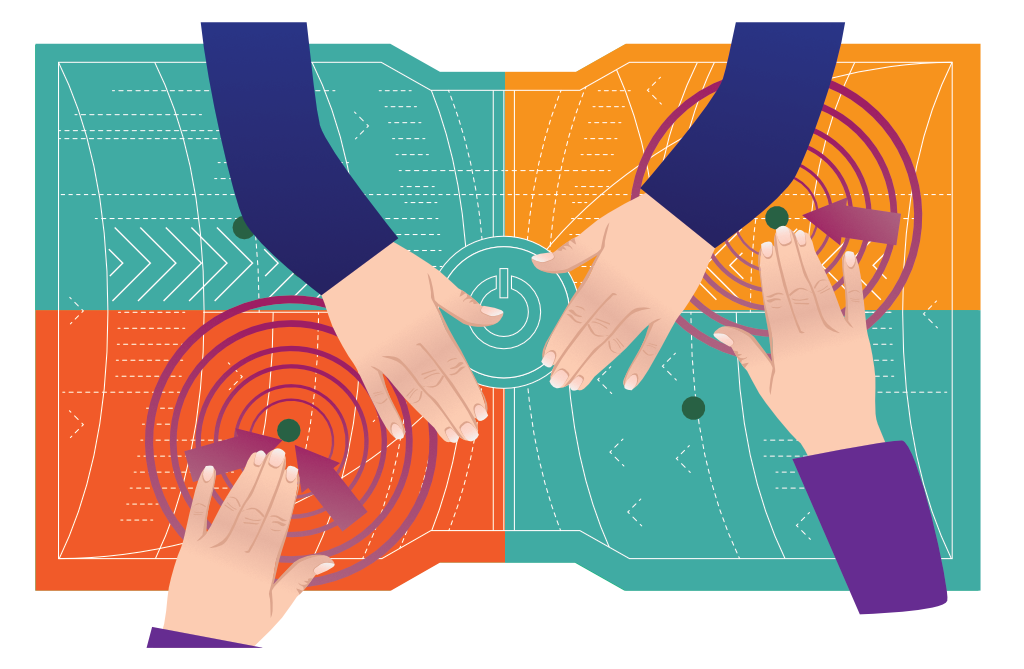
The vibrations in the pillow can be programmed to create specific vibratory behaviors. For example, when both sides are touched simultaneously, the vibration will increase. The standard vibrotactile behavior is the mirroring behavior: touch on one end of the pillow is mirrored with vibrations on the other end. The service provider offers a coaching process in which the family member and the person with dementia are instructed together in using Tactile Dialogues and also co-create the vibration patterns together. In collaboration with a motivational therapist, the vibrotactile behavior of the pillow can be adapted to the person. An example of a tailored vibration is a game in which the people have to move their hands to find where the vibration is coming from.
Interaction behaviors tailored to the person with dementia. Illustration by Carolina Gómez Naranj.
The Tactile Dialogues pillow
The Tactile Dialogues pillow was developed in such a way that it looks inviting for the client, but is still perceived as respectful towards the communication partner. It is meant to fit within modern eldercare organizations, but could also be placed in a living room. The functional properties gave direction to the aesthetic choices during the design process. For example, we chose for a pillow based on the knowledge that people with dementia react better to the outside world when there is extra weight on their bodies. The choices for the tactile properties of the fabric resulted after conducting tests from which we concluded that different surfaces trigger different hand movements. For example, a thick layered fabric would trigger plucking movements, and ridges in the fabric would trigger rubbing with the hands.
Tactile Dialogues pillow. Photo by Wetzer & Berends.
Details
Designers: Martijn ten Bhömer, Borre Akkersdijk, Oscar Tomico
Partners: TU/e, TextielMuseum TextielLab, De Wever, byBorre, Optima Knit, Metatronics
This paper investigates different roles that prototypes play during the development of digital Product Service Systems (PSSs). A literature review reveals that prototyping supports designers during the design process, as well as during knowledge sharing processes with stakeholders. To create a better understanding of these two co-existing roles of prototyping, we executed a research-through-design project in the healthcare domain. This design project was centred around the development of four different prototypes that the designer sequentially developed. A major input into the design process was co-reflection sessions between the designer and different stakeholders. We analysed the prototyping process and the co-reflection sessions. Moreover, we executed a conversational analysis to understand the actual knowledge sharing processes between the designer and the different stakeholders. The results present a detailed overview of the different (co-existing) roles of the prototypes. We distinguished two new types of prototypes which were both related to the development of the intangible aspects of the digital PSS: (1) service interface prototrial aimed at exploring several options for detailing the different intangible aspects of the digital PSS, and (2) service provotype to stimulate collaborative creation of the intangible aspects of the digital PSS in an early stage.
@article{new-roles-of-prototypes-during-the-co-development-of-digital-pss,title={The (New) Roles of Prototypes During the Co-Development of Digital Product Service Systems},author={Kleinsmann, Maaike S. and {ten Bhömer}, Martijn},year={2020},month=apr,publisher={International Journal of Design},volume={14},pages={65--79},journaltitle={International Journal of Design},issue={1},}
2016
Designing ultra-personalised embodied smart textile services for well-being
Martijn ten Bhömer, Oscar Tomico, and Stephan A G Wensveen
In Advances in Smart Medical Textiles, Oxford, Jan 2016
Smart textiles are becoming more integrated with service ecosystems that go beyond the current horizontal textile value chain. This will extend the material and tangible properties of smart textiles to intangible properties from services, such as the ability to measure and store data and change the functionality of a material over time. It is thus becoming more urgent for textile developers and service providers to work closer together to develop these types of smart textile services (STSs). This opens up a vast field of opportunities for textile developers, product designers, and service designers to combine their disciplines to develop close-to-the-body applications in the area of well-being. The role of the body, the degree of personalisation, and the prototyping process provide opportunities for ultra-personalisation within these new types of embodied STSs. We present an overview of commercially available STSs based on these three elements. We then analyse three STSs that we have developed in the context of well-being. We advocate that within the exemplified STSs the service interface is strongly connected to the bodily senses of the people using the service. This connection is further specified with three notions of ultra-personalisation: personalisation through the material properties, the design of the garment, and the programming of the interactions with the wearer.
@incollection{designing-ultra-personalised-embodied-smart-textile-services,title={Designing ultra-personalised embodied smart textile services for well-being},author={{ten Bhömer}, Martijn and Tomico, Oscar and Wensveen, Stephan A G},year={2016},month=jan,booktitle={Advances in Smart Medical Textiles},location={Oxford},publisher={Woodhead Publishing},pages={155--175},doi={10.1016/B978-1-78242-379-9.00007-4},editor={van Langenhove, L},}
Designing embodied smart textile services: The role of prototypes for project, community and stakeholders
The age of wearables has been a prophecy for decades, with visions such as the disappearing computer bringing technology everywhere around us. Previously rigid and hard technology is being transformed and shaped to the body, for example in wristbands, activity trackers and glasses. This raises the question as to how close-to-the-body products and services can become truly meaningful to people’s lives, and more closely connected to our bodily experiences than the current generation of wearable technology. Technological developments in textiles and technology make it possible to augment the existing qualities of textiles with sensing capability (for example, measuring touch, stretch, movement, light, and sound) and actuation capabilities (for example, changing heat, color, light, and shape). By combining intangible properties from services (for example, the ability to measure and store data or change the functionality of a material over time), it becomes possible to tailor smart textiles to individual users. Smart Textile Services are a type of Product-service Systems (PSS’s) where the value for the end-user is achieved by combining an interactive physical component (the smart textile) with intangible components, such as digital data or interpersonal relations. The influence of embodiment, emotions and the phenomenological significance of ways of expression on the service are aspects not widely recognized in service design because service research has always focussed on an information process approach. Both the design process and the result tend to be disembodied, because of limited awareness of the corporal, situated and social elements.
@misc{designing-embodied-smart-textile-services,title={Designing embodied smart textile services: The role of prototypes for project, community and stakeholders},author={{ten Bhömer}, Martijn},year={2016},month=feb,note={Doctoral dissertation},type={phdthesis},editor={Hummels, Caroline and Tomico, Oscar and Kleinsmann, M S},institution={Eindhoven University of Technology},}
2015
Tactile Dialogues: Personalization of Vibrotactile Behavior to Trigger Interpersonal Communication
Kimberly Johanna Schelle, Carolina Gomez Naranjo, Martijn ten Bhömer, and 2 more authors
In Proceedings of the Ninth International Conference on Tangible, Embedded, and Embodied Interaction, Stanford, California, USA, Jan 2015
This article describes tests that have been conducted with Tactile Dialogues, a textile pillow that can react to touch with vibrotactile stimuli and haptic sensations. Tactile Dialogues is designed to stimulate movement and interpersonal contact for patients in the late stages of dementia, their family members and their caregivers. The most recent prototype of the pillow has been tested during 15 separate visits of family members or caregivers with patients. The aim of these tests is to find out whether personalization of the vibrotactile stimuli is appreciated over a mirroring vibrotactile behavior. We propose a three-scale measurement to help family members and caregivers examine the responses of the patient: muscular relaxation, physical movement and interpersonal contact. Through the semi-structured interviews we identified that family members and caregivers do appreciate the opportunity to personalize the vibrotactile behavior and that the pillow mainly functions as a way to establish communication with the patient.
@inproceedings{personalization-of-vibrotactile-behavior,title={Tactile Dialogues: Personalization of Vibrotactile Behavior to Trigger Interpersonal Communication},author={Schelle, Kimberly Johanna and Gomez Naranjo, Carolina and {ten Bhömer}, Martijn and Tomico, Oscar and Wensveen, Stephan},year={2015},month=jan,booktitle={Proceedings of the Ninth International Conference on Tangible, Embedded, and Embodied Interaction},location={Stanford, California, USA},publisher={Association for Computing Machinery},address={New York, NY, USA},series={TEI '15},doi={10.1145/2677199.2687894},}